Manage

The budget that didn't exist at your last review appears the day you resign. What that usually means.
Should a physician accept a counteroffer?
Only if it fixes the reason you were leaving, in writing. Most physicians resign over call burden, shrinking autonomy or a promise that never materialized, and a raise doesn't touch any of those. If money was genuinely the issue and the fix is permanent and documented, staying can be right. Otherwise you're being paid to keep living with the problem.
You finally work up the nerve to resign, and something strange happens. The employer who couldn't find a nickel for you at your last review suddenly finds a budget, and a title, and a warm speech about how valued you are.
It arrives fast, and it feels wonderful, the way flowers feel wonderful. Worth remembering that flowers usually show up right after someone realizes they've done something wrong.
Why it matters: You will make this decision in about seventy-two hours, while flattered, exhausted and relieved that the hard part is over. That is the worst possible state for a decision this size, and the speed is not an accident.
What the counteroffer is actually solving
Let me be fair to it first. Sometimes it's sincere. But it helps to know what it usually is underneath the good feelings.
Replacing you is expensive and slow: the search, the credentialing, the coverage gap, the ramp-up while someone new learns the place. All of that is a real cost the organization would love to avoid this quarter.
Dr. Jeff Williams, who spent twenty years on the hiring side, has put a number on it.
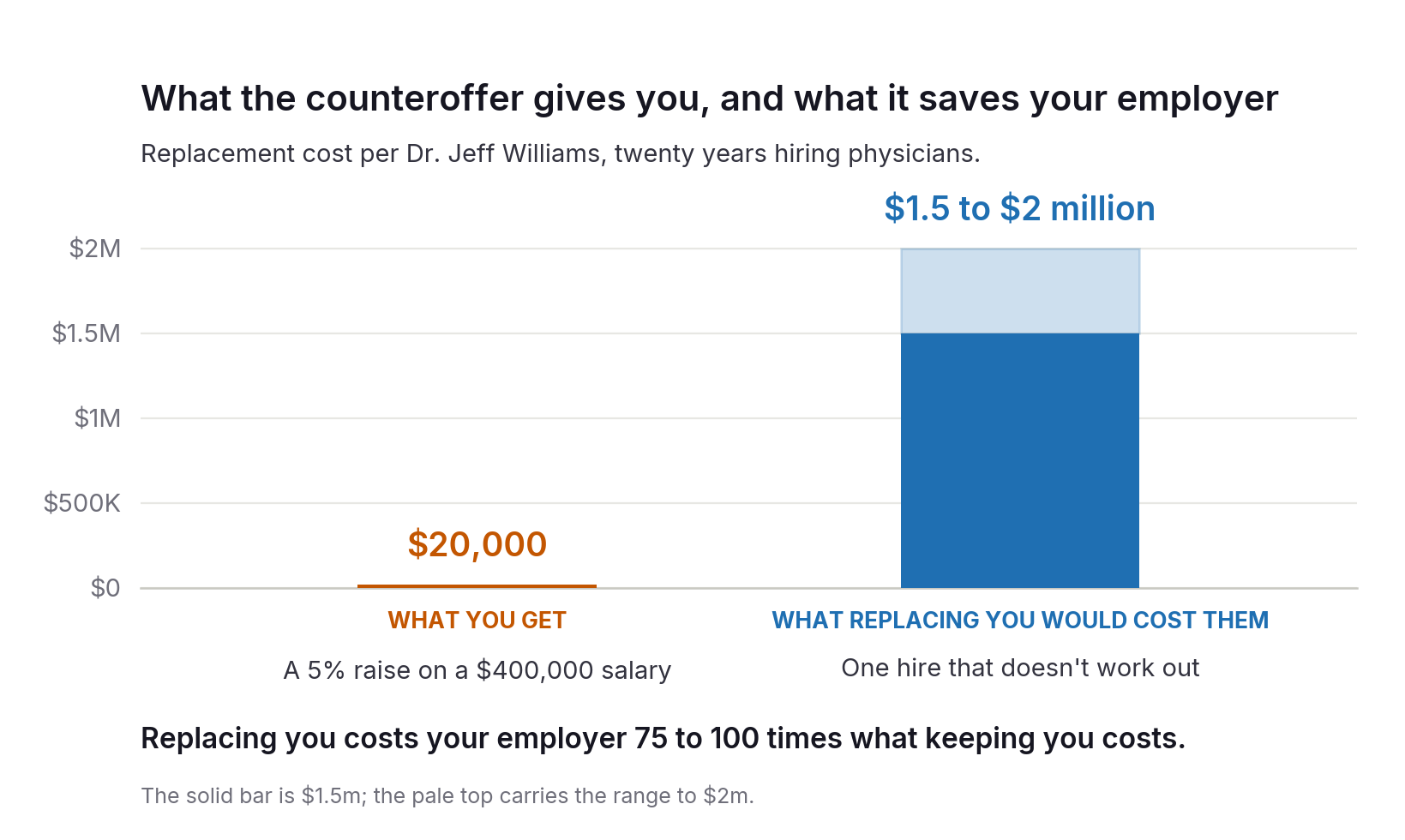
"They'll prop up a new rockstar doctor, and then within six months there are problems, and they quietly shuffle them out the door. You've lost a million and a half, two million dollars in lost revenue and recruiting."
Against $1.5 to $2 million, a raise is cheap. The counteroffer is the fastest, least expensive way to make that number go away. It doesn't have to be cynical to be, first and foremost, a solution to their problem rather than yours.
A 5% raise on a $400,000 salary is $20,000. Replacing you costs 75 to 100 times that.
A raise is a strange remedy for the thing you were actually leaving over
Here's the question the flowers are designed to keep you from asking: does this fix the reason you started looking?
If you went looking over money, and the money is now genuinely and permanently fixed in writing, then maybe you stay. That's a real case.
But most of the physicians I've talked to weren't leaving over the number. They were leaving over the call that never let up, the autonomy that kept shrinking, the promise from two years ago that never materialized, or a culture that slowly stopped feeling like theirs. A raise doesn't touch any of that. It puts a price on staying long enough for the same problem to find you again, usually around month seven, right after the glow wears off.
Be honest with yourself about which camp you're in, because the counteroffer is very good at blurring the line. Money is the reason most people give for leaving, partly because it's the cleanest thing to say out loud and partly because it's the only reason an exit interviewer knows how to write down. When I ask physicians what really pushed them, the money is rarely the whole answer and often barely in it.
The cost nobody mentions while the flowers are fresh
You've now told your employer, out loud, that you were halfway out the door. That knowledge doesn't go away because you stayed.
The next time a stretch assignment gets handed out, or a leadership seat opens up, or layoffs get discussed in a room you're not in, you're the one they already know was looking.
Sometimes that's fine and everyone's an adult about it. Sometimes you've just agreed to a raise in exchange for becoming, quietly, the person they'll replace first when it's convenient. That isn't always the trade. It's the trade more often than the speech admits.
I've watched this play out more than once: a physician accepts a good counteroffer and spends the following year discovering that the call burden driving him out is exactly as bad as it was the week he resigned, now with a slightly bigger number attached. The money bought the hospital a year. It bought him a delay and a more awkward second resignation.
4 questions before you answer
- Would this offer exist if I hadn't threatened to leave? If no, sit with what that says about how your worth gets calculated there.
- Does it fix the actual problem, or pay me to keep living with it? This is the one that decides it.
- Is the fix in writing, with a date? A verbal promise to "look at the call schedule" is the same promise that didn't materialize last time.
- What happens to the relationship now that they know? Ask yourself honestly, and watch how they behave over the next month rather than how they talk this week.
The bottom line
When the flowers arrive, and they probably will, enjoy the moment of being wanted. You earned it.
Then get quiet and ask whether more money solves the thing you were leaving over, or just pays you to keep living with it. If it fixes the real problem, stay, and mean it. If it only quiets the symptom, what you're holding isn't a fresh start. It's a nice gesture that fades about as fast as the flowers do.
Questions physicians ask about counteroffers
How do I know if a counteroffer is sincere?
Sincere offers are specific and documented. They name the schedule change, the FTE, the effective date, the reporting line. Insincere ones are warm and general, promising that leadership "hears you" and that things are "already changing." If what you were leaving over can't be written into an amended agreement, it hasn't been fixed, it's been postponed.
Will accepting a counteroffer hurt my standing?
It can. Your employer now knows you were prepared to leave, and that information persists. It doesn't always matter, and plenty of people accept counteroffers and stay happily for years. But it becomes a factor in decisions made about you that you're not in the room for, and nobody mentions that while the offer is on the table.
What should I ask for if I'm considering staying?
Whatever you were actually leaving over, in writing, with a date. If it's call, ask for the specific rotation and the coverage plan when someone is out. If it's autonomy, ask what decisions become yours and who signs off now. If it's a promise from two years ago, ask what changed that makes this time different. Pay is the easiest thing for them to give and usually the least of what you needed.
Can I accept a counteroffer after I've already signed elsewhere?
You're in a different situation once you've signed. A signed physician contract is enforceable, and backing out can mean repaying a signing bonus or relocation money, and in some cases more. It also ends the relationship with that employer and, in a small specialty market, word travels. Talk to a contract attorney before you do anything, not after.