tag
Career Hub Blog Post 4
 Matt Cybulsky, PhD
•
3 min read
Matt Cybulsky, PhD
•
3 min read

You matched, you trained, you got the offer. But the employment contract in front of you is written to protect the employer — not you. Here are the five clauses physicians most often overlook, and the questions to ask before you sign.
Most physicians see their first real contract at the busiest, most exhausting point of their career. The instinct is to skim, sign, and move on. That instinct is expensive. A single sentence about tail coverage or a non-compete radius can cost tens of thousands of dollars and constrain where you're allowed to practice for years.
This guide walks through what to look for, in plain language, with real examples pulled from contracts we've reviewed with physicians navigating their first and second jobs.
1. Non-compete radius and duration
A non-compete restricts where you can work after you leave. Two numbers matter: the radius (how far) and the term (how long). A 25-mile radius means something very different in rural Montana than in Manhattan. If you'd have to move your family to keep practicing, that's a real cost hiding in one sentence.
Related in the Knowledge Base
Non-Compete Clauses by State — where they're enforceable and where they're not.
2. Tail coverage on malpractice insurance
If your policy is "claims-made," you may need tail coverage when you leave — insurance for claims filed after your departure. Who pays for it? Tail can run $20,000–$50,000. Whether that lands on you or the employer is usually decided by one line you can negotiate before signing.
Ask directly: is the policy occurrence-based or claims-made, and if claims-made, who is responsible for the tail? Getting this in writing is one of the highest-leverage things you can do.
3. Call schedule and how it's defined
"Reasonable call" is not a definition. Look for the actual frequency, whether it's shared equally, how it changes as the group grows, and whether there's additional pay. Vague language today becomes a scheduling dispute in year two.
4. Productivity targets and the RVU formula
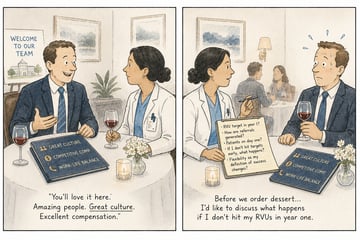
If part of your pay is tied to RVUs (relative value units), understand the conversion factor and the threshold before bonuses kick in. Aggressive targets can turn a strong base salary into a number you rarely actually reach.
Related in the Knowledge Base
Non-Compete Clauses by State — where they're enforceable and where they're not.
5. Termination and "without cause" clauses
Read how either side can end the relationship. A 90-day "without cause" termination cuts both ways — it gives you an exit, but it also means the employer can let you go with three months' notice. Know the number before you sign.
None of these clauses should scare you off a good opportunity. They're simply the places where a few informed questions protect years of your career. When you're ready, a second set of eyes helps — and that's exactly what we do at Tessellate.
Keep exploring
Physicians who read this usually look at these next.
.png?width=360&name=Cartoon%20-%20image%20(42).png)
Who's Actually Keeping Your Money?
A conversation with Dr. Jeff Williams: neuroradiologist, practice president, ...
The $500,000 Job That's Poorer Than the $400,000 One.
A conversation with Dr. Jeff Bettag: a neurology resident at Vanderbilt who's ...
Your Recruiter Is Very Nice. That's Not the Same as Being on Your Side.
A conversation with Dr. Jeff Williams — neuroradiologist, practice president, ...